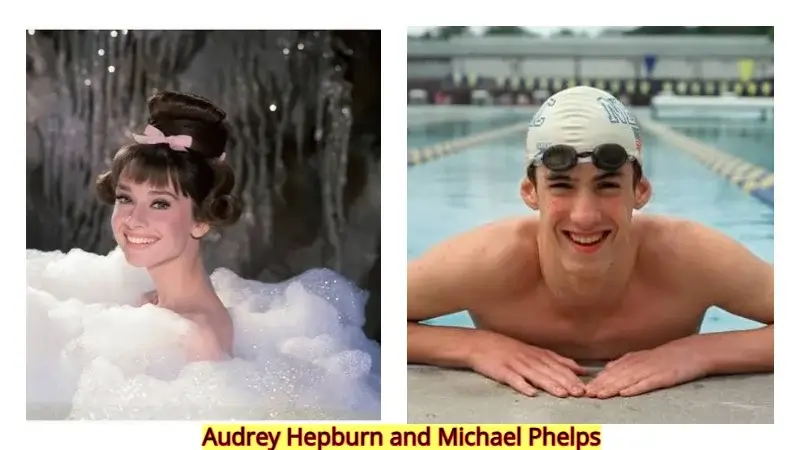
Quick answer: Audrey Hepburn and Michael Phelps are not known to be related, and no credible biography documents a meeting or collaboration between them. Their names belong to entirely different worlds: Hepburn was an Oscar-winning British actress and UNICEF ambassador, while Phelps is an American swimmer whose 28 Olympic medals make him the most decorated Olympian in history. The timeline matters. Hepburn died on January 20, 1993, when Phelps was seven, years before his Olympic debut in 2000. The most accurate way to understand this pairing is as a comparison of two exceptional careers—and of the very different forms a lasting legacy can take.
Audrey Hepburn and Michael Phelps at a Glance
| Quick fact | Audrey Hepburn | Michael Phelps |
|---|---|---|
| Born | May 4, 1929, Brussels, Belgium | June 30, 1985, Baltimore, Maryland |
| Primary field | Film and stage acting | Competitive swimming |
| Defining achievement | Best Actress Oscar for Roman Holiday | Record 28 Olympic medals, including 23 gold |
| Major service work | UNICEF Goodwill Ambassador | Founder of the Michael Phelps Foundation |
| Career-defining period | Hollywood stardom in the 1950s and 1960s | Five Olympic Games from 2000 to 2016 |
What the Pairing Actually Represents
There is no documented personal, family or professional connection. Institutional profiles from UNICEF, the Academy of Motion Picture Arts and Sciences, and Olympic organizations describe two separate lives, with no shared project or relationship. They were born 56 years apart. Hepburn’s major film career was already established more than three decades before Phelps first appeared at the Olympics.
The pairing therefore makes sense only as a comparison. Both names represent rare achievement, instant recognition and work that continued beyond the arena in which each became famous. That common ground is real, but it should not be mistaken for evidence that they knew or influenced one another.
Audrey Hepburn: From Roman Holiday to UNICEF
Born in Brussels in 1929, Hepburn studied ballet before moving into stage and screen work. Her international breakthrough came in William Wyler’s Roman Holiday (1953), in which she played a princess briefly escaping royal duties in Rome. The role earned her the Academy Award for Best Actress at the 1954 ceremony, an unusually decisive arrival for a performer in her first major Hollywood lead. The Academy’s official record lists Hepburn as the winner.
Hepburn followed that success with a varied run of films, including Sabrina, Funny Face, The Nun’s Story, Breakfast at Tiffany’s, Charade, My Fair Lady and Wait Until Dark. Her slim silhouette, close collaboration with designer Hubert de Givenchy and understated screen manner helped reshape the image of a Hollywood leading woman. Yet style alone does not explain her staying power. Her best performances joined poise with alert comic timing and a sense of vulnerability that kept elegant characters from feeling remote.
Her final public chapter was humanitarian rather than cinematic. Hepburn served as a UNICEF Goodwill Ambassador from 1988 until her death in 1993. She visited programs in Ethiopia, Turkey, Central and South America, Bangladesh, Thailand, Viet Nam and Sudan, spoke to political leaders, and used interviews to draw attention to children affected by famine, poverty and conflict. She received the Presidential Medal of Freedom in 1992. UNICEF’s profile of Audrey Hepburn records both the breadth of those missions and the personal importance she attached to aid after her own wartime childhood.
Michael Phelps: The Standard for Olympic Success
Phelps was born in Baltimore in 1985 and reached his first Olympics at 15. He placed fifth in the 200-meter butterfly at Sydney 2000, then returned at Athens 2004 to win six gold and two bronze medals. Four years later in Beijing, he won all eight events he entered. That performance surpassed swimmer Mark Spitz’s record of seven gold medals at one Olympic Games and became the defining feat of Phelps’s career.
His full Olympic record is even more imposing: 28 medals—23 gold, three silver and two bronze—earned across Athens, Beijing, London and Rio. He competed at five Games in total, though he did not medal in Sydney. The U.S. Olympic & Paralympic Museum and Olympics athlete profile identify him as the Olympic medal leader. His eight golds in Beijing remain the record for a single Games.
Phelps ended his competitive career after Rio 2016, but he had already begun building work beyond elite sport. Founded in 2008, the Michael Phelps Foundation provides education centered on water safety, healthy living, confidence and mental wellness. Its IM Program works through partner organizations to help young people develop swimming skills and emotional resilience. The foundation’s official overview describes a mission that links safety in the water with wellbeing outside it.
A Side-by-Side Timeline
| Year | Audrey Hepburn | Michael Phelps |
|---|---|---|
| 1929 | Born in Brussels on May 4 | — |
| 1953–1954 | Roman Holiday opens; Hepburn wins Best Actress | — |
| 1985 | An established actress living largely away from Hollywood | Born in Baltimore on June 30 |
| 1988 | Begins serving as a UNICEF Goodwill Ambassador | — |
| 1992 | Receives the Presidential Medal of Freedom | — |
| 1993 | Dies in Switzerland on January 20 | Seven years old |
| 2000 | — | Makes Olympic debut in Sydney at 15 |
| 2008 | — | Wins eight Beijing golds and establishes his foundation |
| 2016 | — | Finishes his Olympic career with 28 medals |
Two Different Kinds of Excellence
A Defining Performance Became Shorthand for Each Career
For Hepburn, Roman Holiday was both a breakthrough and an award-winning statement of her screen identity. For Phelps, Beijing 2008 condensed years of training into nine days of unprecedented Olympic success. Those achievements became convenient symbols, but neither person’s career can be reduced to one role or one meet. Hepburn kept testing her range in musicals, thrillers and dramas. Phelps sustained medal-winning form across four consecutive Olympics.
Their Influence Moved Beyond Entertainment and Sport
Hepburn converted celebrity into direct advocacy for children, undertaking demanding field missions during the last years of her life. Phelps built an organization around water safety and healthy development, later incorporating mental wellness into its programs. The causes and methods differ, but both careers show how a famous name can support practical work rather than exist only as a personal brand.
Their Legacies Require Different Measures
A film performance cannot be scored like a race, and an Olympic medal count cannot capture the cultural effect of a screen actor. Hepburn’s influence lives through cinema, fashion history and UNICEF’s memory of her service. Phelps’s rests on measurable sporting records, the standard he set for modern swimmers and his work in water-safety education. Comparing them is useful only when those differences remain clear.
Frequently Asked Questions
Are Audrey Hepburn and Michael Phelps related?
No family relationship between them is recorded. They came from different countries, generations and professional backgrounds.
How old was Michael Phelps when Audrey Hepburn died?
Phelps was seven years old. He was born on June 30, 1985, and Hepburn died on January 20, 1993.
What was Audrey Hepburn’s greatest career achievement?
Her Best Actress Oscar for Roman Holiday is her clearest individual film honor. Her wider legacy also includes celebrated roles in Breakfast at Tiffany’s and My Fair Lady, as well as her UNICEF service.
How many Olympic medals did Michael Phelps win?
He won 28: 23 gold, three silver and two bronze. No Olympian has won more total medals.
What charitable causes are associated with them?
Hepburn advocated for children through UNICEF. Phelps’s foundation focuses on water safety, healthy living, confidence-building and mental wellness.
Conclusion
Audrey Hepburn and Michael Phelps did not share a documented relationship or career. Their connection is comparative: one became a defining figure of twentieth-century cinema and a committed UNICEF ambassador; the other became the most decorated Olympian and turned his platform toward water safety and wellbeing. Treating their stories separately preserves what is distinctive about each—and provides a more accurate answer than trying to force a link that the historical record does not support.
Read also Selena Gomez and Jeff Greene: Is There a Real Connection?